Thursday, January 30, 2014

APOD 3.3

 See Explanation.  Clicking on the picture will download
 the highest resolution version available.

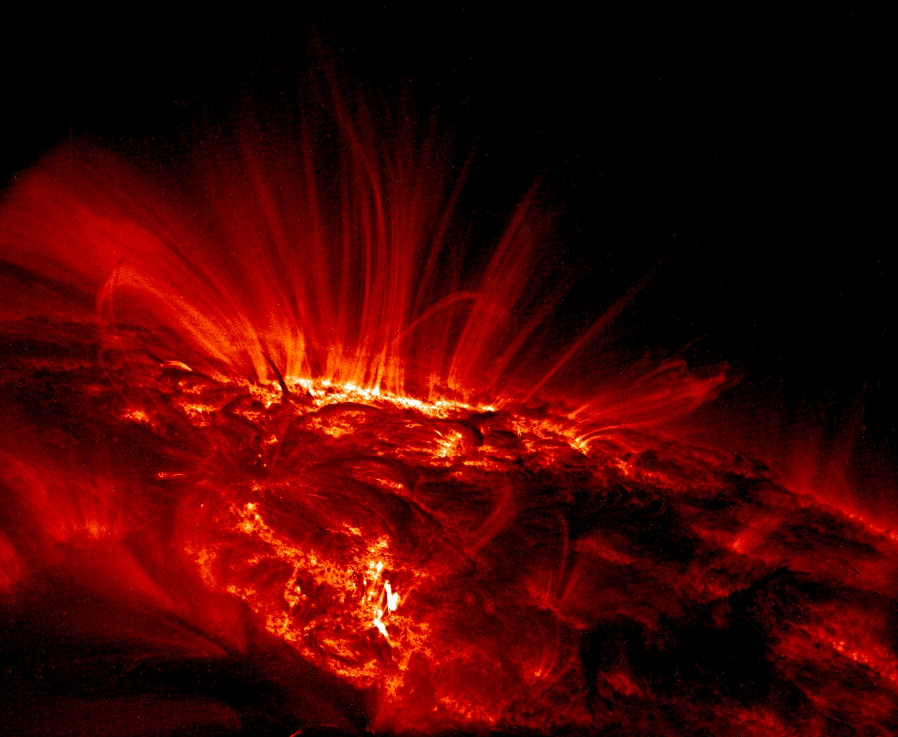
This photo of the sun's surface shows that, although it may not be a busy day on the sun, there is still booming activity occuring. The ultraviolet light setting allows us to see the flares in a more difinitive view and be able to distinguish between the hotter and cooler areas of the sun. Magnetic field loops heavily influence these solar flares, sun spots, and temperature changes throughout the sun's composition and atmosphere.I chose this photo because he have recently discussed a chapter on the sun and took a test on it and I find it convenient to relate my weekly APODs to classroom lessons as much as possible.


Friday, January 24, 2014

APOD 3.2


Shown above is the double cluster within the constellation Perseus, the Hero. Spotted just to the right of the center of the photo, the clusters can be identified as NGC 869 and NGC 884 and contain stars that are much younger than the sun. These clusters are most likely the result of the same star formation. The deep red colors are due to the Hydrogen emissions and are enhanced for viewing preferences. The other cluster seen just to the left of the main double cluster is thought to be related to it and is known as NGC 957. 

Friday, January 17, 2014

Observation

The moon was just approaching its Full Moon phase, just ending its waning gibbous phase, in the night sky. Juipter was seen brightly and appeared like a star. It is extremely close to the earth and is the closest it will all year. Mercury can be vaguely seen close to the horizon and will appear just after the sun sets.

APOD 3.1


The Seagull Nebula, pictured above, is named for its bird-like appearance due to the expanding glow of the gas and dust particles. It stretches a 1.6 degree wide area through teh Milky Way near Sirius. This space includes the object NGC2327 which forms the head of the bird, granting its name the Parrot Nebula. The red glow this Nebula gives off is due to the presence of atomic hydrogen and is spanned over a distance of 3,800 light years.

Friday, January 10, 2014

Great Star Count

From where I live I would say it was about a Magnitude 3 or 4 night sky as I observed a faint cluster of of the stars that make up the constellation Cygnus.

Q2 Observation 4


Date: January 5, 2014
Time:  7:00-9:00
Place: Sarasota
Sky Conditions: Clear Skies

Instruments Used: Naked Eye

Planets: Jupiter

Bright Stars noted: Vega, Deneb, Altair, Polaris, Algol

Constellations noted: Lyra, Aquila, Delphinus, Cygnus, Hercules, Perseus

Deep Sky Objects: M57, M13

Other: Milky Way, First Quarter Moon

Q2 Observation 3


Date: January 7, 2014
Time: 9:00-9:00
Place: Venice
Sky Conditions: Clear Skies

Instruments Used: Naked Eye

Bright Stars noted: Vega, Deneb, Altair, Polaris, Gamma Andromeda

Constellations noted: Lyra, Aquila, Delphinus, Cygnus, Hercules, Pegasus, Andromeda

Deep Sky Objects: M57, M13, M31

Other: Milky Way, First-Quarter Moon

Thursday, January 9, 2014

Friedrich Georg Wilhelm von Struve

              Born April 15, 1793 in Altona, Germany, Friedrich Georg Wilhelm von Struve was born to German-Russian astronomer Jacob Struve who became a sort of inspiration for his future studies and mother Maria Emerentia, daughter of the local pastor. Studying at University of Dorpat, Struve began studying philology before turning his attention to astronomy and going on to be a major professor of mathematics and astronomy and became second in a dynasty of astronomers spanning five generations. Before long he was called to superintend a project of construction for a new observatory near St. Petersberg, later becoming the director of the observatory, to be named the Pulkovo Observatory. In November of 1864 Struve died and was buried in St. Petersberg due to failing health at age of 71.
Specializing in the observations of double stars, Struve conducted a list in 1827 of all the known double stars observed and are contained in his pivotal work: Stellarum duplicium et multiplicium mensurae micrometricae. These observations were found through a 9.5" refractor and the Dorpat  meridian circle from the northern coast of Norway to Ismail. Another accomplishment includes the redetermination of the "constant of aberration"- the yearly approximation that a star or other  astronomical object will undergo aberrational displacement resulting from Earth's orbit around the sun.  Earlier measurments of double stars were conducted by astronomers William Herschel and John Herschel and are whom Struve originated his work off of. 
The Pulkovo Observatory is still standing today in St. Petersberg, Germany and is open for visitation by appointment if anyone venturing to Germany is interested in touring it.

Saturday, January 4, 2014

Q2. Observation 2


Date: Dec. 14, 2013
Time:  7:30-9:30
Place: Nokomis
Sky Conditions: Clear Skies

Instruments Used: Naked Eye

Bright Stars noted: Vega, Deneb, Altair, Polaris

Constellations noted: Lyra, Aquila, Delphinus, Cygnus, Hercules

Deep Sky Objects: M57, M13

Other: Milky Way, Third Quarter Moon

Q2. Observation 1


Date: Dec. 3, 2013
Time:  8:00-10:00
Place: Osprey-Sarasota
Sky Conditions: Clear Skies

Instruments Used: Naked Eye, iPhone App

Planets: Venus

Bright Stars noted: Vega, Deneb, Altair, Polaris, Alberio

Constellations noted: Lyra, Cygnus, Aquila, Delphinus, Ursa Minor

Deep Sky Objects: M57,

Other: Milky Way, New Moon