Friday, May 16, 2014

APOD 4.8


This image was taken by the Voyager 2 spacecraft August 25, 1989, the only spacecraft to visit the planet Neptune. Majority of the planet, its rings and moon Triton are dimmed by the scene. This was the first opportunity for the rings of Neptune to be imaged by Voyager 2. The background field of stars centers on the constellation Camelopardalis correlating to the Voyager's view of Neptune and its planetary system.


Wednesday, May 14, 2014

APOD 4.7


During the early morning hours of May 6 Halley's comet ignited the night sky in a fluid of colors and jet stream appearance in the moonless night. This occurrence happens one a year and is known as Eta Aquarids and arcs along the path of the Milky Way at about 66 km/s. This photo was taken above the waters of a small pond in Albion, Maine. May 24 will exhibit similar show as the dust from Camelopardis scatters the night sky in a meteor shower.

APOD 4. 6


Pictured above is an aurora located near Fairbanks in northern Alaska which has taken the unusual form of, what is being called, a jumping dog. The photo was taken through a wide-angled lens during a 15 second exposure, coincidentally capturing a variety of familiar constellations and sky objects. From left to right, on the bottom Mars can be seen by the dog's hind legs and Procyon and Betelgeuse are visible near the front legs. Directly above the dog's tail is a perfect image of Ursa Major, otherwise known as the Big Dipper, and Auriga above his head. Other noticeable artifacts include Arcturus, Jupier and Auriga. 

Astronomer Eugene Parker

          Eugene Newman Parker was born June 10, 1927 in Houghton MI and is known for his discovery of solar winds. Solar wind is made of plasma and releases stream of particles that flow from the sun as fast as 900 km/s and at temperatures close to 1 million degrees Celsius. Educated at Michigan State University and California Institute of Technology, Parker went on to hold positions in the physics, astronomy and astrophysicist departments and the Enrico Fermi institutes. His work has greatly impacted our understanding of solar winds, solar corona, and magnetic fields of Earth and Sun and their electromagnetic interactions shown in his theory named "Parker's Limit". Parker received the Bruce Medal in 1997- an award given every year by the Astronomical Society of the Pacific for outstanding lifetime contributions to astronomy. In addition, Parker has received a multitude of other various awards from the Astronomical Society, Geophysical Union, National Science Board, and many other organizations recognizing his outstanding achievements in astronomy; Parker even has a Minor Planet named after him: #11756 Geneparker. Parker is still alive and can be found studying at the University of Chicago in the Department of Astronomy and Astrophysics.


Wednesday, April 30, 2014

Astronomer Eugene Parker Sources

http://www.phys-astro.sonoma.edu/brucemedalists/parker/index.html

http://www.nndb.com/people/474/000171958/

http://news.nationalgeographic.com/news/2003/08/0827_030827_kyotoprizeparker.html

Friday, April 25, 2014

MicroObservatory Whirlpool Galaxy

I received three, unprocessed images from the MicroObservatory of the Whirlpool Galaxy: red, blue, and green filtered. By filtering each image with the auto Log setting I was able to brighten the actual galaxy and its dust enough to contrast it from the rest of the universe and various stars and galaxies which surround it. Then by enhancing the color of each photo, I stacked them, shifted the images to line up, and produced the JPG image above.

APOD 4.5

See Explanation.
Moving the cursor over the image will bring up an alternate version.
Clicking on the image will bring up the highest resolution version
available.

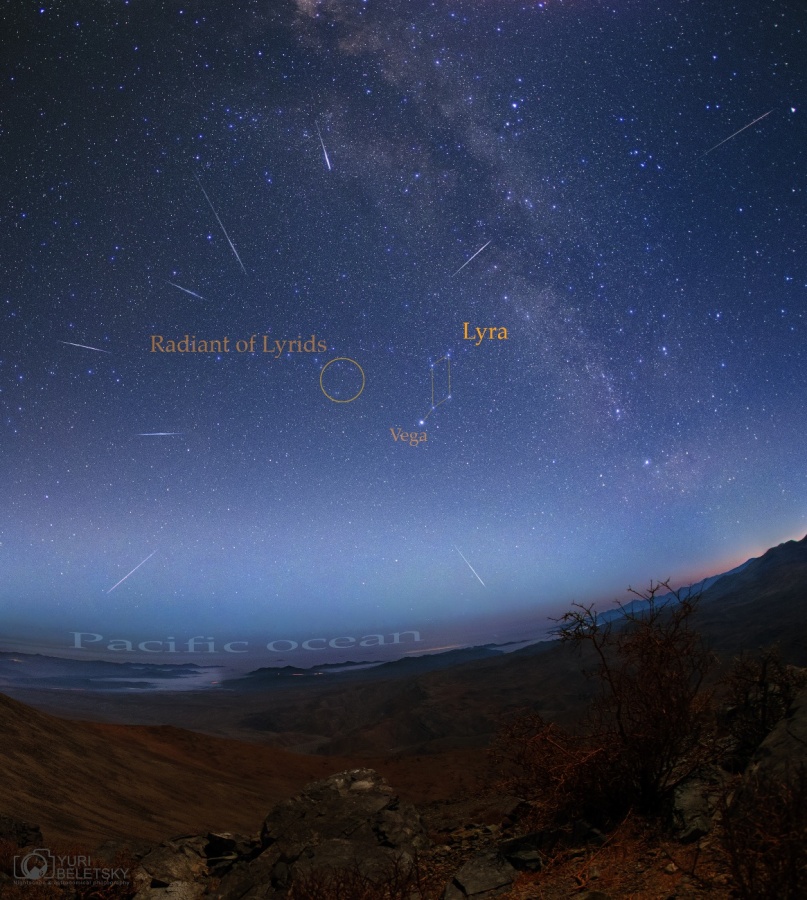
April 22nd featured the Earth's annual Lyrid meteor shower just before dawn. This occurs due to the Earth's rotation in its orbit which goes through a clump of dust from the tail of the comet Thatcher. Photoed above you can see the meteors streaming away from the constellation Lyra, properly named after this Lyrid meteor shower. Beyond the shower, normal stars of our Milky Way Galaxy can be seen.