This image was taken by the Voyager 2 spacecraft August 25, 1989, the only spacecraft to visit the planet Neptune. Majority of the planet, its rings and moon Triton are dimmed by the scene. This was the first opportunity for the rings of Neptune to be imaged by Voyager 2. The background field of stars centers on the constellation Camelopardalis correlating to the Voyager's view of Neptune and its planetary system.
Friday, May 16, 2014
Wednesday, May 14, 2014
APOD 4.7
During the early morning hours of May 6 Halley's comet ignited the night sky in a fluid of colors and jet stream appearance in the moonless night. This occurrence happens one a year and is known as Eta Aquarids and arcs along the path of the Milky Way at about 66 km/s. This photo was taken above the waters of a small pond in Albion, Maine. May 24 will exhibit similar show as the dust from Camelopardis scatters the night sky in a meteor shower.
APOD 4. 6
Pictured above is an aurora located near Fairbanks in northern Alaska which has taken the unusual form of, what is being called, a jumping dog. The photo was taken through a wide-angled lens during a 15 second exposure, coincidentally capturing a variety of familiar constellations and sky objects. From left to right, on the bottom Mars can be seen by the dog's hind legs and Procyon and Betelgeuse are visible near the front legs. Directly above the dog's tail is a perfect image of Ursa Major, otherwise known as the Big Dipper, and Auriga above his head. Other noticeable artifacts include Arcturus, Jupier and Auriga.
Astronomer Eugene Parker
Eugene Newman Parker was born June 10, 1927 in Houghton MI and is known for his discovery of solar winds. Solar wind is made of plasma and releases stream of particles that flow from the sun as fast as 900 km/s and at temperatures close to 1 million degrees Celsius. Educated at Michigan State University and California Institute of Technology, Parker went on to hold positions in the physics, astronomy and astrophysicist departments and the Enrico Fermi institutes. His work has greatly impacted our understanding of solar winds, solar corona, and magnetic fields of Earth and Sun and their electromagnetic interactions shown in his theory named "Parker's Limit". Parker received the Bruce Medal in 1997- an award given every year by the Astronomical Society of the Pacific for outstanding lifetime contributions to astronomy. In addition, Parker has received a multitude of other various awards from the Astronomical Society, Geophysical Union, National Science Board, and many other organizations recognizing his outstanding achievements in astronomy; Parker even has a Minor Planet named after him: #11756 Geneparker. Parker is still alive and can be found studying at the University of Chicago in the Department of Astronomy and Astrophysics.
Wednesday, April 30, 2014
Astronomer Eugene Parker Sources
http://www.phys-astro.sonoma.edu/brucemedalists/parker/index.html
http://www.nndb.com/people/474/000171958/
http://news.nationalgeographic.com/news/2003/08/0827_030827_kyotoprizeparker.html
http://www.nndb.com/people/474/000171958/
http://news.nationalgeographic.com/news/2003/08/0827_030827_kyotoprizeparker.html
Friday, April 25, 2014
MicroObservatory Whirlpool Galaxy
I received three, unprocessed images from the MicroObservatory of the Whirlpool Galaxy: red, blue, and green filtered. By filtering each image with the auto Log setting I was able to brighten the actual galaxy and its dust enough to contrast it from the rest of the universe and various stars and galaxies which surround it. Then by enhancing the color of each photo, I stacked them, shifted the images to line up, and produced the JPG image above.
APOD 4.5

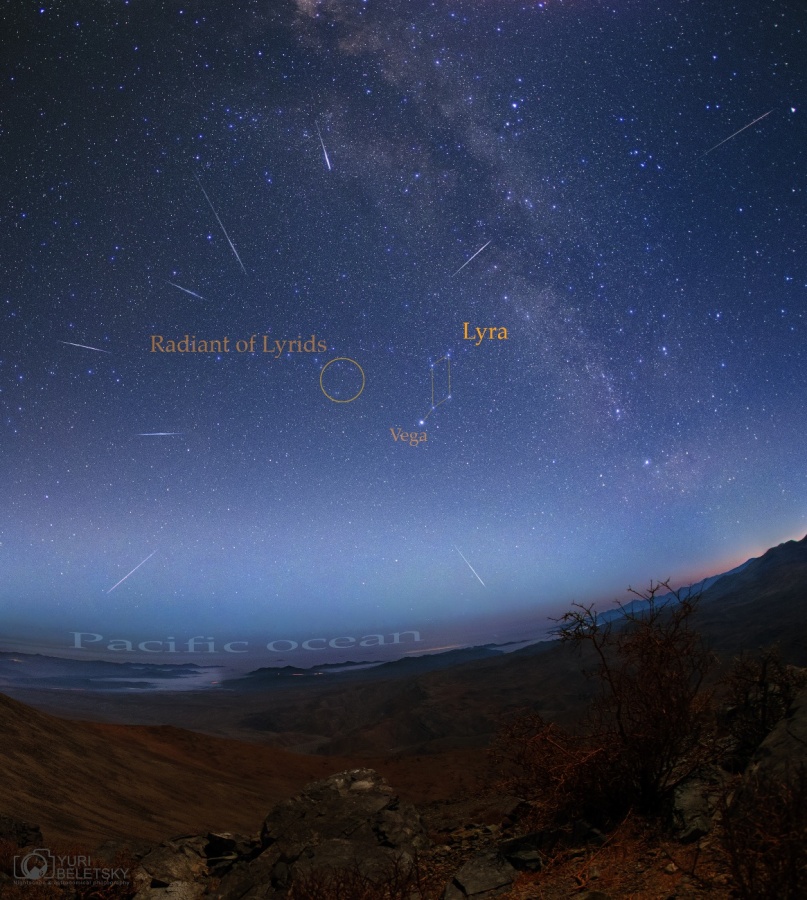
April 22nd featured the Earth's annual Lyrid meteor shower just before dawn. This occurs due to the Earth's rotation in its orbit which goes through a clump of dust from the tail of the comet Thatcher. Photoed above you can see the meteors streaming away from the constellation Lyra, properly named after this Lyrid meteor shower. Beyond the shower, normal stars of our Milky Way Galaxy can be seen.
Thursday, April 17, 2014
Lagoon Nebula MicroObservatory
Pictured above is the Lagoon Nebula that I received from the Micro Observatory and touched up using the downloaded application to fix the image. I used the Log- Auto setting to bring the stars to view and then sharpened the image to extinguish the background noise and pixels that appeared as stars. Then I used the red, blue, and green and stacked them on top of each other to create a fully colored image of the Lagoon Nebula.
APOD 4.4

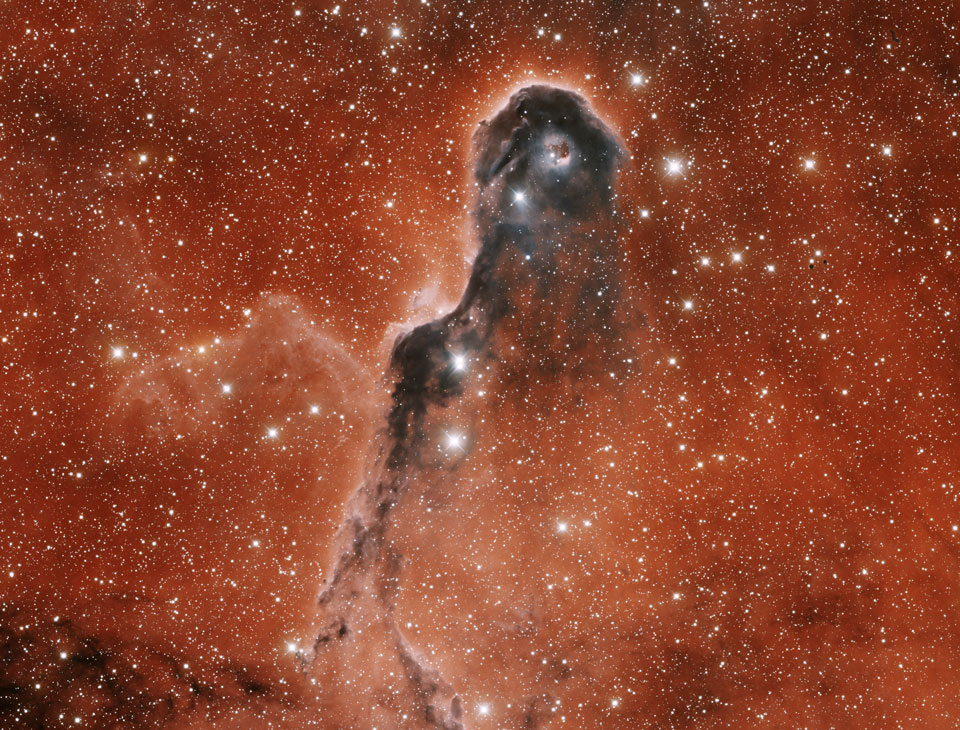
Photoed above is the Elephant's Trunk Nebula, a gas and dust clouded region within star formations that is seen to be taking on an interesting forms. An energetic star far from earth is consuming the dust of the globular towards the top of the image. In doing so, gasses and dusts are being pushed away from the star
forming the above dark cloud stretched across the picture. It is much larger than it appears with a width that covers over 10 full moons.
Friday, April 11, 2014
Observation
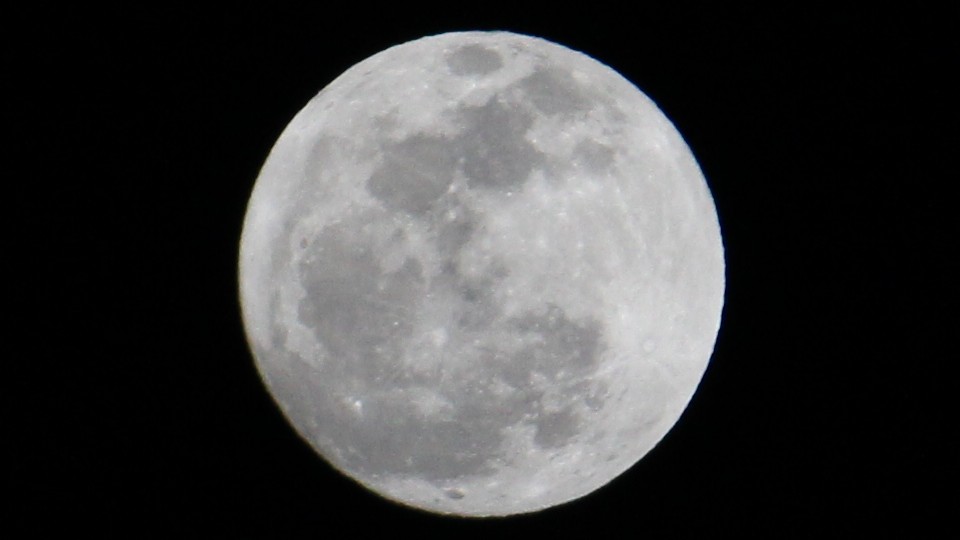
Last night the moon was in its waxing gibbous phase as it approaches the full moon phase. Mars has been approaching its opposition and will appear there around April 14 which is additionally the night that the moon will enter a total eclipse.
APOD 4.3
Tonight Mars will appear between its opposition and closest approach ( April 8 and 14). It goes around the constellation Virgo in the night sky which makes it prime season for telescopic views. This photo was taken on April 3 through a 16-inch diameter telescope from Assis, Brazil. Its tilt shows the polar cap towards the top left The white shapes are orographic clouds (white vapor clouds condensing in teh cold atmosphere). April 14/1 will be the closest approach of Mars and a total eclipse of the Moon. .
Thursday, April 10, 2014
What contribution(s) have been made towards understanding nature/the structure of the Milky Way ?
Galileo-
•stars make up the Milky Way
• 'Why are there invisible objects in the night sky?'
William Herschel-
• Milky Way is disk-shaped!
Harlow Shapely-
• spiral nebulae are nearby clouds of gas within the Milky Way and did not believe they were beyond the Milky Way
•believed it was 300,000 light years in diameter (close, it's actually 100,000)
Edwin Hubble-
• showed that universe was more than just Milky Way
• Milky Way is one of many galaxies
•zone of avoidance around Milky Way
RR Lyrids and Cepheids-
• good 'candles' for things within Milky Way
• about 85,000 in Milky Way
Immanuel Kant-
• many stars are outside of Milky Way
Henrietta Leavitt-
• 'Period-Lumionosity Relationship' to measure distances in the universe
• increased assistance in Hertzsprung with distances of Cepheids in Milky Way
Herber Curtis-
• role in Great Debate with Harlow Shapely
• spiral nebulae a are actually spiral galaxies outside of Milky Way
"The Great Debate"
• Shapely v. Curtis
• 1920
• nature of spiral nebula and size of universe
• Shapely= spiral nebulae are inside Milky Way - increased size of universe
• Curtis= spiral nebulae are galaxies outside Milky Way
•stars make up the Milky Way
• 'Why are there invisible objects in the night sky?'
William Herschel-
• Milky Way is disk-shaped!
Harlow Shapely-
• spiral nebulae are nearby clouds of gas within the Milky Way and did not believe they were beyond the Milky Way
•believed it was 300,000 light years in diameter (close, it's actually 100,000)
Edwin Hubble-
• showed that universe was more than just Milky Way
• Milky Way is one of many galaxies
•zone of avoidance around Milky Way
RR Lyrids and Cepheids-
• good 'candles' for things within Milky Way
• about 85,000 in Milky Way
Immanuel Kant-
• many stars are outside of Milky Way
Henrietta Leavitt-
• 'Period-Lumionosity Relationship' to measure distances in the universe
• increased assistance in Hertzsprung with distances of Cepheids in Milky Way
Herber Curtis-
• role in Great Debate with Harlow Shapely
• spiral nebulae a are actually spiral galaxies outside of Milky Way
"The Great Debate"
• Shapely v. Curtis
• 1920
• nature of spiral nebula and size of universe
• Shapely= spiral nebulae are inside Milky Way - increased size of universe
• Curtis= spiral nebulae are galaxies outside Milky Way
Tuesday, April 8, 2014
MIcro Obsevatory Dumbbell Nebula
I took three photos of the Dumbbell Nebula that I had emailed to me from requesting images- red, blue, and green images of the nebula- and stacked them together to form a full color photo. I had to realign it and use the auto- Linear filter in order to get a better image and diminish the background pixels that didn't need to be viewed. I neglected to crop the photo for a more direct view of the nebula but I could go back and do so if I desired.
Friday, April 4, 2014
Observation

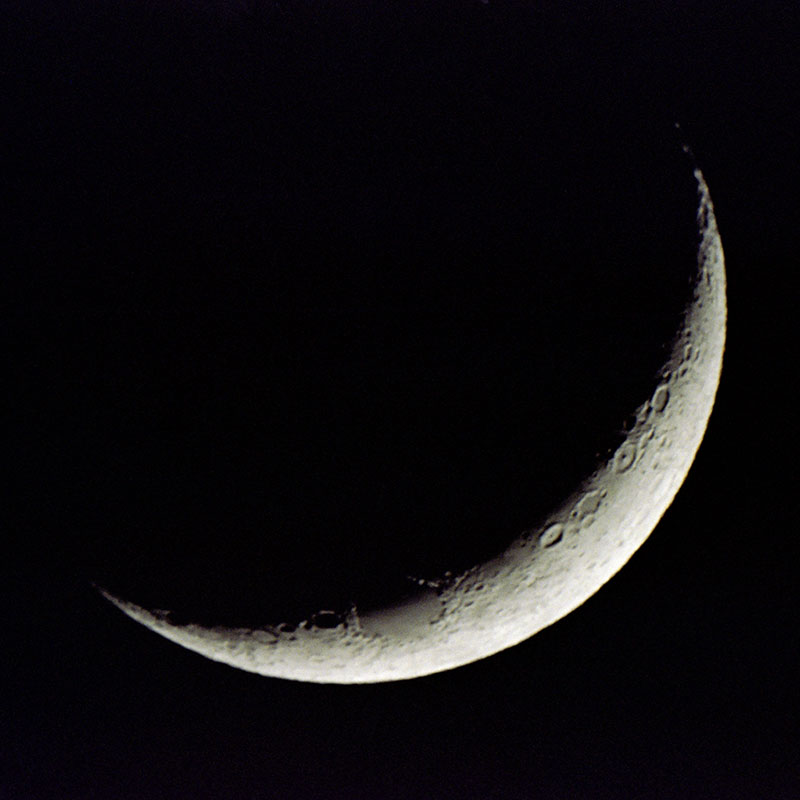
This week's moon phase was a waxing crescent and could be seen throughout the week in the night sky. This morning as I left my house I noticed the moon was shaded by clouds which gave it a viusally misty effect.
APOD 4.2

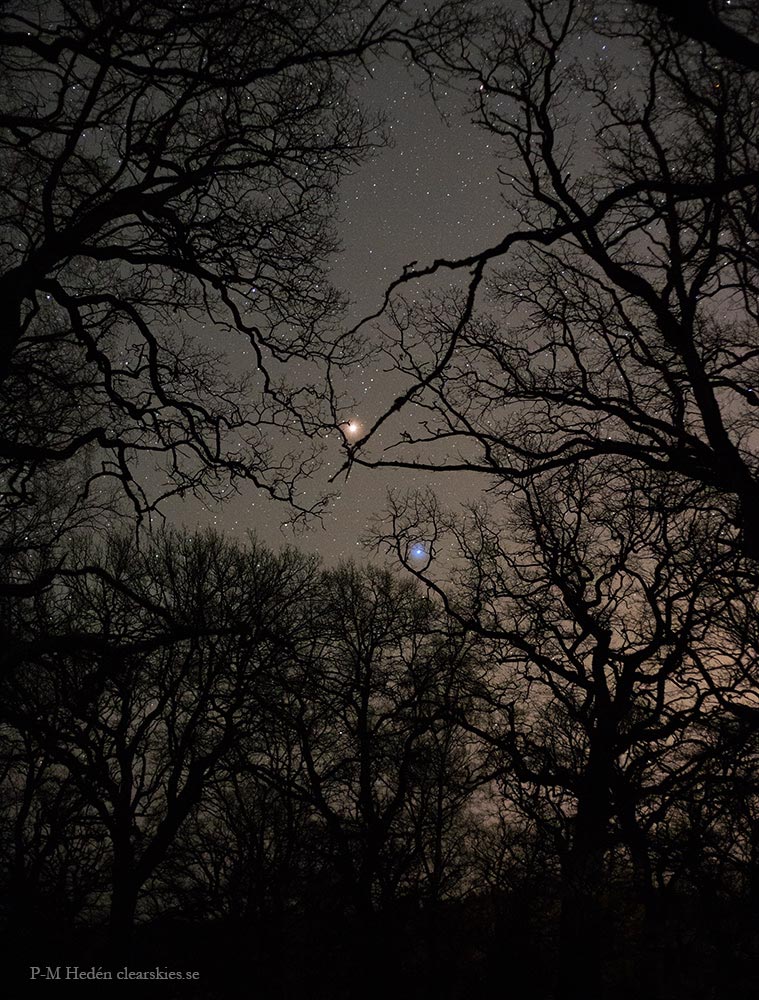
Pictured above is Mars (red) and Spica (blue) brightly shining in the night sky on Wednesday, April 2, 2014. Next week, Mars will reach its optimum brightness in the night sky and will be very clearly visible to the naked eye as it is in this photo. Spica is an incredibly old star having been observed since ancient times. It is known as one of the brightest blue stars in the night sky and is constantly shining. This photo was taken after sunset in Sweden last week.
APOD 4.1

Photoed above is the object M78 within the constellation Orion. Its blue glow and dark swirls are dust that absorbs light (darker portions) and reflects the light of blue stars within the nebula (blue glow). In the center is M78 while NGC 2071 is just to its lower left. The blue color is so bright due to the similar sort of scattering that happens within Earth's atmosphere. The constellation Orion also contains Orion's Belt and the Horse Head Nebula.
Friday, March 21, 2014
Observation

At the beginning of the week the moon entered its 'Full Moon' phase and is approaching the Last Quarter phase which will be completed early next week. Earlier in the week the moon could be seen near Mars in the morning sky on the 19th, which was Wednesday. Yesterday at approximately 12:57 PM the sun crossed into the Northern Celestial Hemisphere and brought the official first day of 2014 Spring. On a separate note, NASA announced its discovery of the first official evidence to prove the Big Bang Theory of our universe. Pretty exciting week in astronomy!
Tuesday, March 18, 2014
Pulsars and Neutron Stars
Neutron Stars:
- 20 km in diameter
- 1.4 times mass of our Sun
- Surface gravitational field of about 2 x 10¹¹
- One possible end to a star
- Appear in supernova remnants, isolated objects, or binary systems
- Four known Neutron Stars have planets
- Rotating Neutron Stars that appear to pulse due to the rotation
- Discovered in 1967 by Jocelyn Bell Burnell
- Jets of particles shoot out almost at the speed of light above the magnetic poles
- Spin axis and Magnetic axis are disaligned (similar to Earth)
Friday, March 7, 2014
Observation
With the new moon premiering on March 1st, we see its transition into waning crescent throughout the week. Photos of the moon earlier in the week show the shadow of Earth reflected in the outline of the moon, blurring the edges of the appearance of the moon. Tonight the moon will appear close to Aldebaran and Pleiades, part of constellation Taurus the Bull .
APOD 3.8
Since we recently learned a lot about the sun in class, this photo of a prominence beyond the edge of the sun proves to be increasingly relevant to classroom material. The prominence photoed above is a sea of hot gas in the chromosphere can be seen in the light reflected by hydrogen. The photo even shows how the Earth is smaller than the prominence. Prominences are incredibly hot, but next to the sun appear darker considering the sun is hotter in comparison. These prominences last normally last about a month and may erupt in a Coronal Mass Ejection, expelling hot gas into the Solar System which could hit the Earth and cause auroras.
Thursday, March 6, 2014
Willem de Sitter
Willem de Sitter
was born on May 6th, 1972, to town judge Lamoraal Ulbo de Sitter and
Catharine Theodore Wilhelmine Bertling de Sitter in the small town of Sneek,
located in northern Netherlands. Although coming from a typical and rather
strict family, Willem developed an imaginative yet intelligent mind that would
serve him greatly for his endeavors as an astronomer and a mathematician. His
intelligence and curiosity from the very beginning is what brought him to
develop an equal and unique passion for mathematics, cosmology, and astronomy.
A successful
mathematician, astrologist, and cosmologist, de Sitter begun his journey at the
University of Groningen, where he majored in mathematics. During his studies he
had a stroke of luck which consisted of him meeting David Gill, who was a
dedicated astronomer. Upon meeting him he consequently was invited to work at
“Her Majesty’s Observatory at the Cape of Good Hope”, from there his astronomic
endeavors took off. Besides his passion for astronomy, Sitter developed
theoretical models of the universe based off Einstein’s general theory of
relativity. Einstein claimed that the universe was static and unchanged;
however, de Sitter claimed that relativity implied the universe was constantly
expanded. Eventually after Edwin Hubble’s observations backed up Sitter’s
claims, Einstein also accepted this idea. Sitter’s contributions and
application of Einstein’s theory to astronomy was revolutionary and is noted as
a basis to many theories and progressions in astronomy as well as cosmology. De
Sitter was director of Leiden observatory until his death November 20, 1934 due
to a brief illness.
Friday, February 28, 2014
Observation
Observation
Throughout this week it has been incredibly difficult to make many observations due to the dense fog and rain that has alternated back and forth. The moon phases for this week have gone from third quarter last Saturday through waning crescent this week, anticipating a new moon for next week. Learning about Carina this week in class I leaned that its First Magnitude star, Canopus, is the second brightest star in the night sky and is a winter constellation making it visible during this time of the year.
APOD 3.7
Photoed above is Praesepe the Beehive cluster, 600 light years away, also known on the star chart as M44. Compared to the sun, M44 is about 600 million years old and is thought to have been born with the star cluster Hayades from the constellation Taurus which we have recently learned about in class through constellation quizzes. M44 is an open cluster that spans about 15 light years across, holding 1,000 stars and covers about 3 full moons in the constellation Cancer. M44 is an easily identifiable night sky object that can be seen without any tools and contains hot blue main sequence stars that are seen within the photo above.
Friday, February 21, 2014
Astronomer Resources- Willem de Sitter
http://www.phys-astro.sonoma.edu/BruceMedalists/deSitter/
http://www.britannica.com/EBchecked/topic/546850/Willem-de-Sitter
http://www.nndb.com/people/209/000168702/
http://www.britannica.com/EBchecked/topic/546850/Willem-de-Sitter
http://www.nndb.com/people/209/000168702/
APOD 3.6
Pictured above is the Tarantula Nebula located in the Large Magellanic Cloud, a small galaxy that orbits the Milky Way galaxy. Named for its spidery appearance, this nebula is about 1,000 light years across and is shown here closest to its true colors. It is near the sight of a close, recent supernova and surrounds NGC 2070, a star cluster containing some of the brightest, most massive stars known which would be explanation for the recent supernova; considering massive stars have short lifespan and die young.
Friday, February 14, 2014
APOD 3.5
The photo above exhibits a descriptive look at a constellation we have recently learned about have been tested on in class: Auriga the Charioteer. Known for its misc. trait 'The Kids', this picture features 2/3: M36 and M38. To the right is the Flaming Star Nebula, also known as IC 405. Auriga is also known for its named star Capella which is unfortunately not pictured above. The boundary to the lower left corner is where Taurus the Bull, another well known constellation, would be found if the picture was imaged to a broader range.
Sunday, February 9, 2014
Observations
Throughout the week it's been hard to see much of anything through the foggy and cloudy night skies which have turned into dense mornings. The first quarter moon was fully presented 1/6 and will now begin phasing into the waxing gibbous and soon the full moon which should take place in one week on 1/14. Hopefully next week will prove clearer and better viewings.
APOD 3.4
The image above exhibits spiral galaxy NGC 2683, a galaxy thought to be similar to our own Milky Way due to its, probable, shared trait of having a bar across the center. Part of the constellation Lynx, commonly known as the Cat, this photo pictures the galaxy as an edge-on view where it is easy to see the visible dust and space clutter which spirals around the outer barriers of its stellar pull.
Thursday, January 30, 2014
APOD 3.3
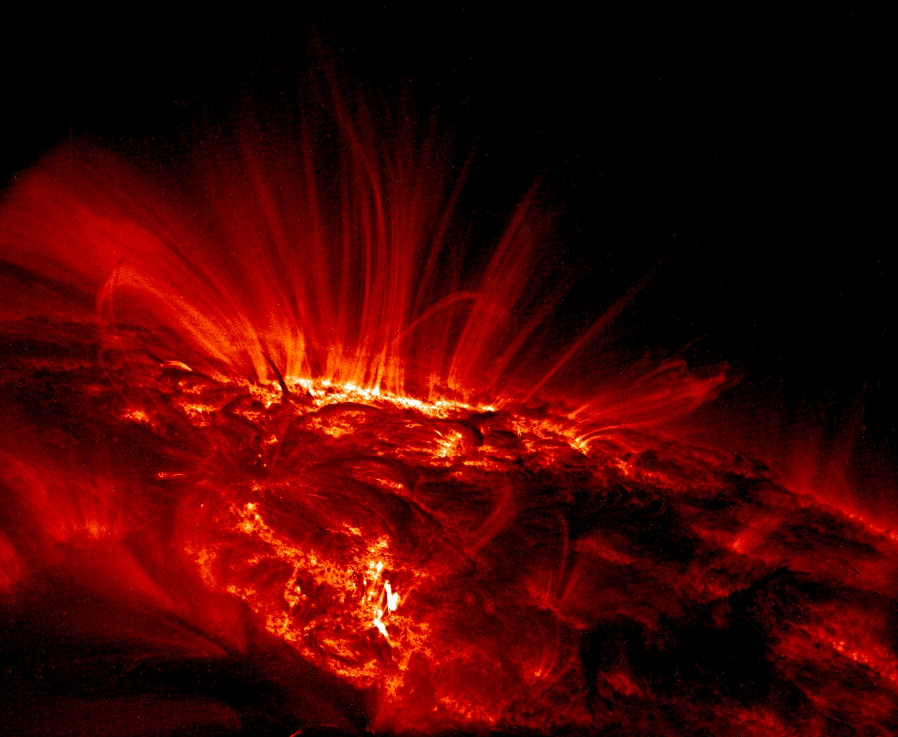
This photo of the sun's surface shows that, although it may not be a busy day on the sun, there is still booming activity occuring. The ultraviolet light setting allows us to see the flares in a more difinitive view and be able to distinguish between the hotter and cooler areas of the sun. Magnetic field loops heavily influence these solar flares, sun spots, and temperature changes throughout the sun's composition and atmosphere.I chose this photo because he have recently discussed a chapter on the sun and took a test on it and I find it convenient to relate my weekly APODs to classroom lessons as much as possible.
Friday, January 24, 2014
APOD 3.2
Shown above is the double cluster within the constellation Perseus, the Hero. Spotted just to the right of the center of the photo, the clusters can be identified as NGC 869 and NGC 884 and contain stars that are much younger than the sun. These clusters are most likely the result of the same star formation. The deep red colors are due to the Hydrogen emissions and are enhanced for viewing preferences. The other cluster seen just to the left of the main double cluster is thought to be related to it and is known as NGC 957.
Friday, January 17, 2014
Observation
The moon was just approaching its Full Moon phase, just ending its waning gibbous phase, in the night sky. Juipter was seen brightly and appeared like a star. It is extremely close to the earth and is the closest it will all year. Mercury can be vaguely seen close to the horizon and will appear just after the sun sets.
APOD 3.1
The Seagull Nebula, pictured above, is named for its bird-like appearance due to the expanding glow of the gas and dust particles. It stretches a 1.6 degree wide area through teh Milky Way near Sirius. This space includes the object NGC2327 which forms the head of the bird, granting its name the Parrot Nebula. The red glow this Nebula gives off is due to the presence of atomic hydrogen and is spanned over a distance of 3,800 light years.
Friday, January 10, 2014
Great Star Count
From where I live I would say it was about a Magnitude 3 or 4 night sky as I observed a faint cluster of of the stars that make up the constellation Cygnus.
Q2 Observation 4
Date: January 5, 2014
Time: 7:00-9:00
Place: Sarasota
Sky Conditions: Clear Skies
Instruments Used: Naked Eye
Planets: Jupiter
Bright Stars noted: Vega, Deneb, Altair, Polaris, Algol
Constellations noted: Lyra, Aquila, Delphinus, Cygnus,
Hercules, Perseus
Deep Sky Objects: M57, M13
Other: Milky Way, First Quarter Moon
Q2 Observation 3
Date: January 7,
2014
Time: 9:00-9:00
Place: Venice
Sky Conditions: Clear Skies
Instruments
Used: Naked Eye
Bright Stars
noted: Vega, Deneb, Altair, Polaris, Gamma Andromeda
Constellations
noted: Lyra, Aquila, Delphinus, Cygnus, Hercules, Pegasus, Andromeda
Deep Sky
Objects: M57, M13, M31
Other: Milky Way, First-Quarter Moon
Thursday, January 9, 2014
Friedrich Georg Wilhelm von Struve
Born April 15, 1793 in Altona, Germany, Friedrich Georg Wilhelm
von Struve was born to German-Russian astronomer Jacob Struve who became a sort
of inspiration for his future studies and mother Maria Emerentia, daughter of
the local pastor. Studying at University of Dorpat, Struve began studying
philology before turning his attention to astronomy and going on to be a major
professor of mathematics and astronomy and became second in a dynasty of
astronomers spanning five generations. Before long he was called to superintend
a project of construction for a new observatory near St. Petersberg, later
becoming the director of the observatory, to be named the Pulkovo Observatory.
In November of 1864 Struve died and was buried in St. Petersberg due to failing
health at age of 71.
Specializing
in the observations of double stars, Struve conducted a list in 1827 of all the
known double stars observed and are contained in his pivotal work: Stellarum
duplicium et multiplicium mensurae micrometricae. These observations
were found through a 9.5" refractor and the Dorpat meridian circle
from the northern coast of Norway to Ismail. Another accomplishment includes
the redetermination of the "constant of aberration"- the yearly
approximation that a star or other astronomical object will undergo
aberrational displacement resulting from Earth's orbit around the sun. Earlier
measurments of double stars were conducted by astronomers William Herschel and
John Herschel and are whom Struve originated his work off of.
The
Pulkovo Observatory is still standing today in St. Petersberg, Germany and is
open for visitation by appointment if anyone venturing to Germany is interested
in touring it.
Subscribe to:
Posts (Atom)